
Opinion
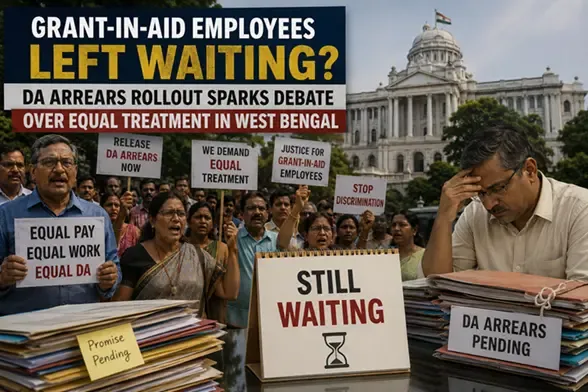
Grant-in-Aid Employees Left Waiting? DA Arrears Rollout Sparks Debate Over Equal Treatment in West Bengal
By MILLENNIUM NEWSROOM Desk · Published: Jun 06, 2026 04:25 AM · Updated: Jul 01, 2026 03:41 AM
4 min read
Grant-in-Aid Employees and the DA Arrears Debate in West Bengal
The implementation of Dearness Allowance (DA) arrears in West Bengal has opened a new chapter in the state's long-running DA dispute. While thousands of state government employees have begun receiving arrears following the Supreme Court's landmark judgment, a significant section of the public workforce continues to await clarity on when they will receive similar benefits.
At the centre of the debate are Grant-in-Aid employees, including teaching and non-teaching staff of government-aided educational institutions, employees of statutory bodies, government undertakings, panchayats, municipalities, and other state-funded institutions.
What the Supreme Court DA Judgment Established
The Supreme Court's ruling in the DA case was widely viewed as a major victory for employees. The judgment reaffirmed that Dearness Allowance is not a discretionary benefit once it is provided under applicable service rules and government orders.
The court also rejected the argument that financial constraints alone could justify withholding a lawful entitlement. For employee organisations, the verdict represented a significant affirmation of workers' rights and the state's obligation to comply with established service conditions.
How the State Government Implemented DA Arrears
Following the judgment, the West Bengal government announced a framework for releasing DA arrears. However, the implementation process created a distinction between regular state government employees and several other categories of workers.
A Finance Department memorandum directed departments to collect and verify pay and service-related details of:
- Teaching staff of government-aided institutions
- Non-teaching staff of aided educational institutions
- Employees of statutory bodies
- Government undertaking employees
- Panchayat employees
- Municipal corporation and municipality employees
- Other Grant-in-Aid employees and pensioners
The memorandum indicated that arrears for these categories would be addressed through a separate mechanism to be announced later.
Why Grant-in-Aid Employees Feel Disadvantaged
The decision has led to growing criticism from employee organisations and staff associations. Many argue that Grant-in-Aid employees have historically been governed by state-approved pay structures and receive benefits linked to government policies.
According to this view, separating them from the first phase of DA arrear payments has created a perception of unequal treatment. Critics argue that if these employees are included in government-approved pay revisions and other service benefits, they should not be treated differently when implementing a judicially recognised entitlement.
For many workers, this represents an unprecedented situation where employees connected to the state's public service framework are being placed in a separate category for the purpose of arrear disbursement.
The Government's Position
The Mamata Banerjee government has defended the decision by citing administrative and procedural differences between direct government employees and employees of aided institutions or autonomous bodies.
Officials have argued that calculating liabilities across thousands of aided institutions requires separate verification of records and financial assessment. According to the government, this additional exercise is necessary before arrears can be released.
Supporters of the government's approach maintain that administrative categorisation does not automatically amount to discrimination and that a separate implementation process is needed to ensure accuracy and accountability.
Questions About Judicial Compliance
Opponents of the government's approach contend that the issue goes beyond administrative procedures. They argue that the spirit of the Supreme Court judgment requires the state to ensure that all eligible employees receive the benefits arising from the ruling without unnecessary distinctions.
They also point out that the government's own memorandum acknowledges Grant-in-Aid employees and pensioners as stakeholders in the arrear process. As a result, the debate is increasingly focused on the timeline and manner of implementation rather than the existence of entitlement itself.
For many employee groups, the larger question is whether compliance with a Supreme Court judgment should occur uniformly across all categories of workers who fall within the state's broader pay and service framework.
The Political Dimension
The controversy has inevitably acquired a political dimension. Opposition parties have criticised the current government for excluding Grant-in-Aid employees from the first phase of arrear payments and have accused it of creating an artificial distinction between categories of workers.
However, there remains a significant uncertainty. While the BJP has frequently supported DA protesters and criticised the state's handling of the issue, it remains unclear whether a future BJP-led government would adopt a different approach when implementing arrears and employee benefits.
Until such a scenario materialises, any conclusion about how a future administration would act remains speculative. For now, thousands of Grant-in-Aid employees continue to wait for clarity on when the benefits acknowledged through the state's own framework will finally reach them.