
National
What is the Red Sea Crisis and How It Is Affecting the Indian Economy
By MILLENNIUM NEWSROOM Desk · Published: May 31, 2026 02:27 AM · Updated: Jun 30, 2026 09:29 PM
7 min read
The ongoing Red Sea crisis has emerged as one of the most significant geopolitical and economic disruptions affecting global trade in recent years. What initially appeared to be a regional maritime security issue has now evolved into a major international supply-chain crisis with deep consequences for economies that depend heavily on maritime trade routes. India, whose economy is closely linked with global shipping corridors for both imports and exports, finds itself particularly vulnerable.
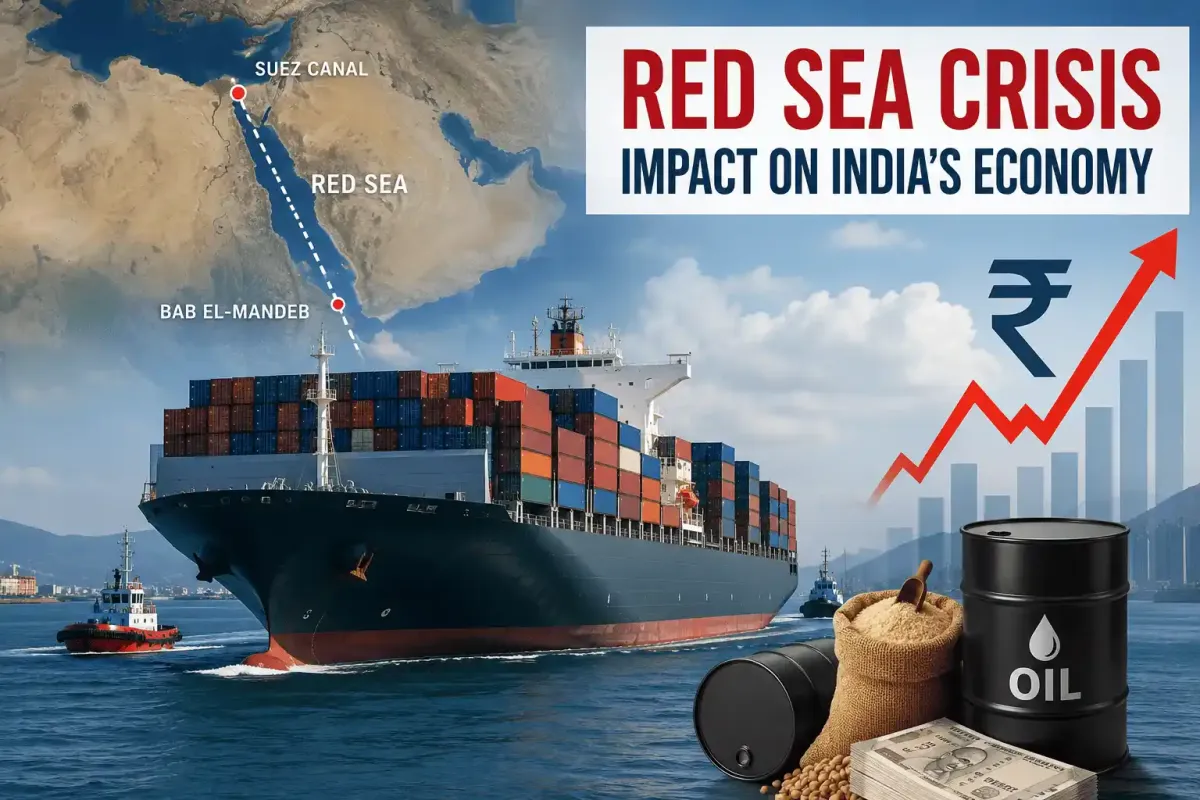
The Red Sea serves as a crucial maritime passage connecting the Indian Ocean to the Mediterranean Sea through the Suez Canal. Nearly 12 percent of global trade and about 30 percent of global container traffic passes through this route. For India, the route is even more important because a substantial portion of its trade with Europe, West Asia, and parts of Africa depends on the Red Sea corridor.
What is the Red Sea Crisis?
The Red Sea crisis began intensifying after attacks on commercial vessels in the Red Sea and Gulf of Aden by Yemen’s Houthi rebels. These attacks were linked to the broader geopolitical tensions in West Asia, particularly the Israel-Gaza conflict and increasing confrontations involving Iran and Western powers. Shipping companies started considering the route unsafe, leading many global carriers to suspend movement through the Suez Canal and reroute vessels around the Cape of Good Hope in southern Africa.
This rerouting may appear simple geographically, but economically it is extremely costly. The alternative route adds nearly 3,500 nautical miles and can increase shipping times by 10 to 20 days depending on the destination.
Major shipping companies such as Maersk and CMA CGM either suspended transit temporarily or imposed emergency surcharges due to rising security threats and insurance costs. Freight rates for several Asia-Europe routes surged sharply, while war-risk insurance premiums increased significantly.
The crisis is no longer merely about attacks on ships. It has become a broader issue involving disrupted supply chains, higher logistics costs, delayed deliveries, inflationary pressure, and currency instability across import-dependent economies like India.
Why the Red Sea Matters So Much to India
India’s dependence on maritime trade makes the Red Sea crisis particularly dangerous. According to analyses by policy and trade experts, nearly 80 percent of India’s external trade by volume passes through the Red Sea route. This includes approximately 50 percent of exports and 30 percent of imports.
India imports several essential commodities through this corridor, including:
- Crude oil
- Natural gas
- Fertilisers
- Capital goods
- Industrial machinery
- Automobile components
- Electronics
At the same time, India exports products such as:
- Textiles
- Pharmaceuticals
- Rice and agricultural products
- Petroleum products
- Engineering goods
The disruption of this route therefore creates a double-sided economic pressure. Imports become more expensive while exports become less competitive globally.
Rising Shipping Costs and Import Burden
One of the earliest and most visible effects of the Red Sea crisis has been the sharp rise in freight charges. Shipping companies taking the Cape of Good Hope route consume more fuel, spend more time at sea, and require higher operational expenditure. These additional costs are ultimately passed down to importers and consumers.
Reports indicate that freight rates on key India-Europe shipping routes rose by nearly 40 to 50 percent during the escalation of the crisis. Some industry analyses even suggested container costs surged by 200 to 300 percent in specific sectors due to congestion and emergency surcharges.
This is especially damaging for India because the country imports a massive quantity of crude oil. India imports nearly 85 to 90 percent of its oil requirement from abroad. Even small increases in shipping and insurance costs can substantially raise the country's import bill.
The cost escalation does not stop with oil. Fertilisers imported from West Asia, especially from Israel, Jordan, and Egypt, also face delays and higher transport costs. Sustained disruptions in fertilizer supply could affect Indian agricultural productivity in the long term.
Electronics manufacturers, automobile companies, and pharmaceutical firms are also facing delays in receiving critical components. Industries operating on just-in-time supply systems become especially vulnerable because delayed shipments disrupt production schedules.
Impact on Indian Exports
The Red Sea crisis is not only increasing import costs but also weakening Indian exports.
Indian exporters are facing:
- Longer delivery times
- Higher container costs
- Increased insurance premiums
- Reduced global competitiveness
For sectors operating on thin margins, these additional logistics expenses can be devastating. Agricultural exports, especially perishable goods, are particularly vulnerable because delays can damage product quality and reduce demand.
India’s basmati rice exporters have reported challenges in overseas markets as shipping costs increased. Textile exporters have also expressed concerns about reduced competitiveness in European markets.
The Federation of Indian Export Organisations has warned that billions of dollars worth of exports could be affected if the disruption continues. For an economy aiming to strengthen manufacturing under initiatives like Make in India, prolonged supply-chain disruption creates a major obstacle.
How the Red Sea Crisis Is Affecting the Indian Rupee
One of the most worrying economic consequences of the Red Sea crisis is its indirect impact on the Indian rupee.
India’s currency is highly sensitive to oil prices and import expenditure. When import bills rise sharply, the demand for US dollars increases because oil and most international commodities are traded in dollars. This puts downward pressure on the rupee.
The mechanism is relatively straightforward:
- Higher oil and freight costs increase India’s import bill.
- Indian companies need more dollars to pay for imports.
- Demand for dollars rises in currency markets.
- The rupee weakens against the dollar.
Persistent oil price increases linked to disruptions in West Asia could widen India’s current account deficit significantly while weakening the rupee further.
A weaker rupee creates another layer of economic pain because imports become even more expensive. This creates a vicious cycle where rising import costs weaken the currency, and the weaker currency further increases import costs.
Inflation and Rising Prices in India
The weakening rupee and higher import costs eventually translate into inflation for ordinary citizens.
India’s economy remains heavily dependent on imported fuel. When crude oil becomes expensive, transportation costs rise across sectors. Since transport is embedded into almost every economic activity, inflation spreads rapidly through the system.
The impact can be seen in petrol and diesel prices, LPG cylinder prices, food transportation costs, airline ticket prices, consumer electronics, medicines, fertilisers, and manufacturing costs.
Financial Problems Faced by Ordinary Indians
Higher Fuel Prices
If crude oil prices rise due to prolonged disruptions, petrol and diesel prices in India may increase. This affects both personal transportation and public transport expenses.
Costlier Food
Higher transportation and fertiliser costs can increase food prices. Vegetables, grains, packaged food, and milk products all become more expensive when logistics costs rise.
Expensive Consumer Goods
India imports large quantities of electronics, machinery, and industrial inputs. A weaker rupee makes imported smartphones, laptops, appliances, and automobile components more costly.
Increased EMI Burden
If inflation remains high, banks may maintain elevated interest rates. Home loans, vehicle loans, and personal loans therefore become more expensive.
Pressure on Small Businesses
Small and medium enterprises relying on imported raw materials may struggle with higher operational costs. Profit margins shrink, potentially leading to layoffs or reduced expansion.
Reduced Savings Power
Inflation erodes purchasing power. Even if salaries remain unchanged, households effectively become poorer because basic necessities cost more.
Impact on India’s Economic Growth
The Red Sea crisis also threatens India’s broader growth trajectory. Higher oil prices and supply-chain disruptions can increase India’s current account deficit and fiscal burden. Foreign investors also tend to become cautious during geopolitical crises, resulting in capital outflows and additional pressure on the rupee.
India’s Possible Responses to the Crisis
- Diversifying trade routes.
- Expanding strategic petroleum reserves.
- Increasing domestic manufacturing.
- Strengthening currency stability through RBI intervention.
- Expanding bilateral trade settlements in local currencies.
Conclusion
The Red Sea crisis has demonstrated how deeply interconnected the global economy has become. A conflict affecting a maritime corridor thousands of kilometers away is now influencing fuel prices, inflation, trade, and currency stability inside Indian households.
For India, the crisis presents multiple simultaneous challenges. Shipping disruptions are increasing import costs, delaying exports, weakening the rupee, and contributing to inflationary pressures. The longer the disruption continues, the greater the pressure on economic growth, business profitability, and household finances.